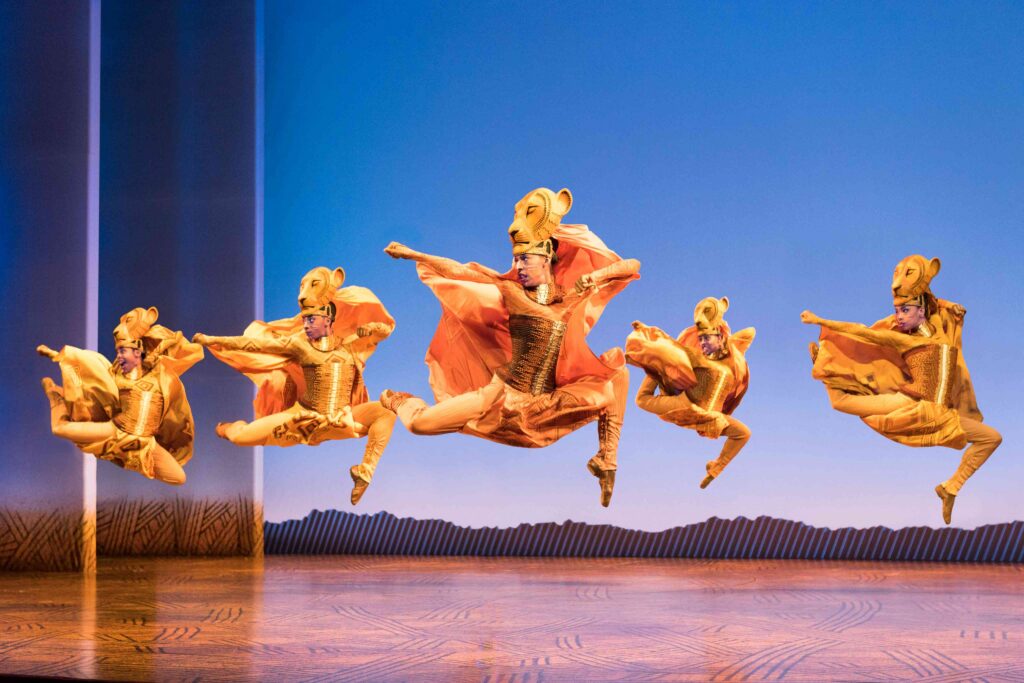
Photo by Deen Van Meer
There are Broadway openings, and then there is the entrance of the animals in The Lion King. As the first notes of “Circle of Life” fill the theater and the procession moves toward the stage, even the most seasoned theatergoers tend to surrender to the moment. Nearly three decades after its Broadway premiere, that opening remains one of musical theater’s great spectacles—and Louisville audiences will experience it again when Disney’s The Lion King returns to Whitney Hall November 12–29, 2026.
The story is familiar, but its theatrical presentation remains anything but ordinary. Young Simba is born into royalty as the son of Mufasa, the beloved king of the Pride Lands. His future appears secure until his jealous uncle Scar conspires with the hyenas to seize the throne. After tragedy drives Simba into exile, he grows up alongside the carefree Timon and Pumbaa, embracing their “Hakuna Matata” philosophy while trying to escape his past. When the Pride Lands deteriorate under Scar’s rule, Simba must decide whether to remain hidden or return home, confront his guilt and accept his rightful place in the circle of life.
The narrative draws from myth, family drama and Shakespearean tragedy, particularly Hamlet, but The Lion King succeeds because its spectacle never overwhelms its emotional center. This is a story about grief, identity, responsibility and the difficult process of becoming the person—or lion—you were meant to be. Children respond to its humor, adventure and colorful characters, while adults often find deeper meaning in Simba’s struggle with memory, loss and legacy.
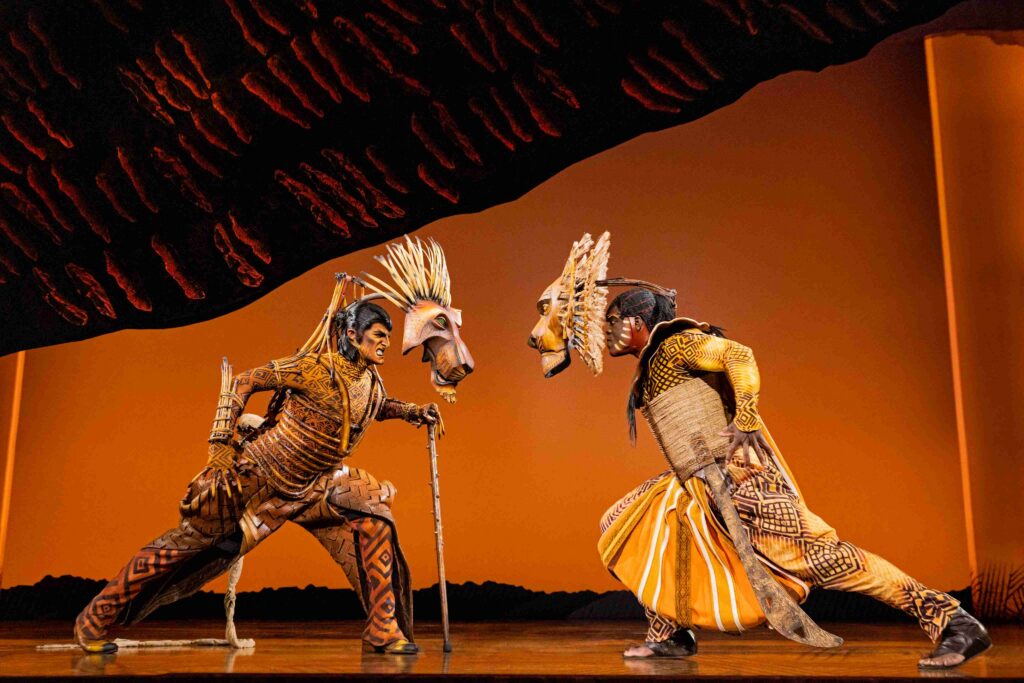
Photo by Evan Zimmerman
For Broadway aficionados, the production’s greatest fascination lies in director Julie Taymor’s refusal to simply reproduce Disney’s animated film onstage. The actors are not hidden inside conventional animal costumes. Instead, Taymor and designer Michael Curry expose the mechanics of the transformation through masks, puppetry, fabric, movement and silhouette. Audiences can see both the performer and the animal at once, creating a visual language that invites them to participate imaginatively.
That choice is essential to the production’s lasting power. Scar’s mask shifts above the actor’s face, giraffes emerge through performers walking on stilts and a cheetah moves through an intricate fusion of human gesture and articulated puppetry. An entire savanna materializes from grass-covered headdresses, while the stampede unfolds through a breathtaking combination of choreography, scenic design, lighting and perspective. The effects are sophisticated, yet the production retains the handcrafted quality that makes live theater feel immediate.
The score also extends well beyond the songs audiences remember from the film. Elton John and Tim Rice’s “Circle of Life,” “I Just Can’t Wait to Be King,” “Hakuna Matata,” “Be Prepared” and “Can You Feel the Love Tonight” remain central, but the stage production expands its musical world through contributions from Lebo M, Mark Mancina, Jay Rifkin, Taymor and Hans Zimmer. African rhythms, choral passages and additional songs give the musical a richer dramatic vocabulary. “He Lives in You,” “Shadowland” and “Endless Night” deepen the emotional lives of Rafiki, Nala and Simba while adding textures that distinguish the theatrical production from its animated source.
The production earned six Tony Awards in 1998, including Best Musical. Taymor won for both direction and costume design, becoming the first woman to receive the Tony for Best Direction of a Musical. The show also earned awards for Garth Fagan’s choreography, Richard Hudson’s scenic design and Donald Holder’s lighting design. Those honors demonstrate why the production remains so highly regarded: its theatrical disciplines do not merely coexist; they combine to create a complete and unmistakable stage language.
Its longevity is equally remarkable. The Lion King opened on Broadway in 1997 and has become one of the longest-running and most successful productions in Broadway history. Yet brand recognition alone cannot explain that endurance. Audiences return because the musical offers something increasingly rare: grand-scale entertainment infused with genuine artistic vision. It can introduce a child to the wonder of live theater while rewarding experienced patrons who notice the precision of a puppet’s movement, the detail of a mask or the way a lighting cue transforms Whitney Hall into the African savanna.
This Louisville engagement is more than an opportunity to revisit a beloved story. It is a chance to experience a landmark production that helped redefine what a Broadway musical could look and feel like. Whether this is your first journey to Pride Rock or a return visit, expect “Circle of Life” to produce the same response it has inspired for generations: wonder, applause and the exhilarating realization that live theater can make the familiar feel completely new.
The production runs approximately two hours and 30 minutes, including one intermission, and is recommended for ages six and older.
For tickets and more information, visit Louisville.Broadway.com