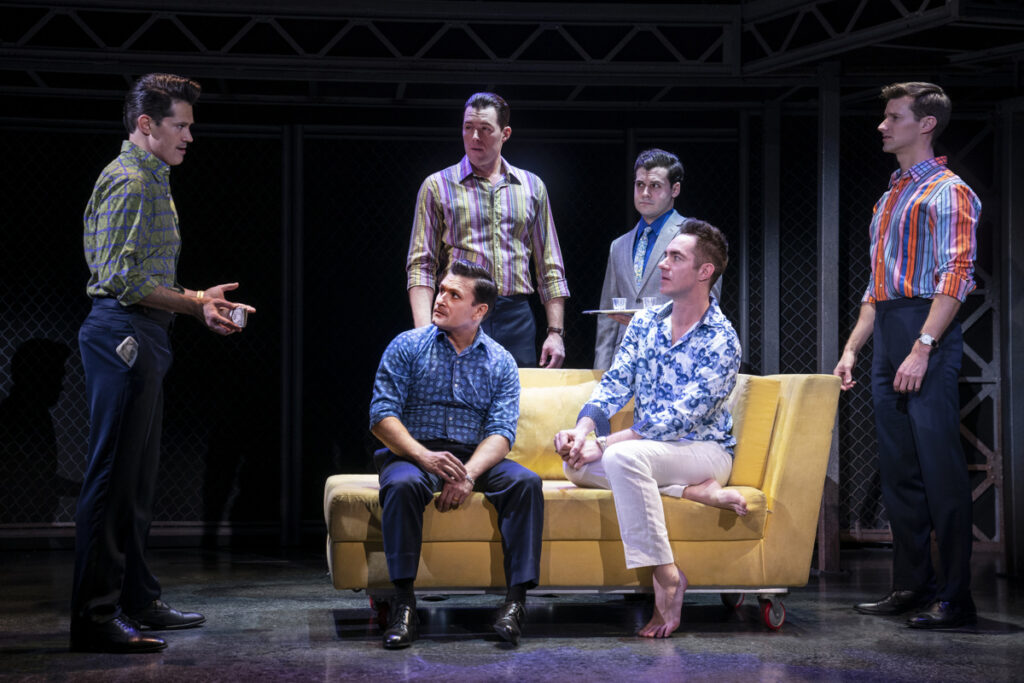
Before Frankie Valli and The Four Seasons became one of the defining sounds of the 1960s, they were four young men from working-class New Jersey neighborhoods trying to find the combination that would turn talent into success. Their journey—from street-corner harmonies and small clubs to sold-out performances and the Rock & Roll Hall of Fame—drives Jersey Boys, the Tony Award-winning musical returning to Louisville for the first time in 16 years. The show opens the 2026–2027 PNC Broadway in Louisville season at Whitney Hall October 6–11, 2026.
Anyone expecting a conventional jukebox musical may be surprised by the dramatic muscle beneath those polished harmonies. Jersey Boys certainly delivers the hits, but it is not simply a Frankie Valli and The Four Seasons tribute concert wrapped in a loose narrative. Marshall Brickman and Rick Elice’s book presents a candid backstage chronicle of ambition, loyalty, crime, money, fame and the personal costs of keeping a group together long after its members begin pulling in different directions.
The story is divided into four “seasons,” with each section narrated by a different member of the group. Tommy DeVito tells the story through spring, Bob Gaudio takes summer, Nick Massi guides the audience through fall and Frankie Valli closes with winter. Each man offers his own version of how the group came together, why it succeeded and who deserves the credit—or blame—for what happened next. The shifting perspectives give the musical more dimension than the standard rise-and-fall biography. As the characters repeatedly remind us, everyone remembers the past a little differently.
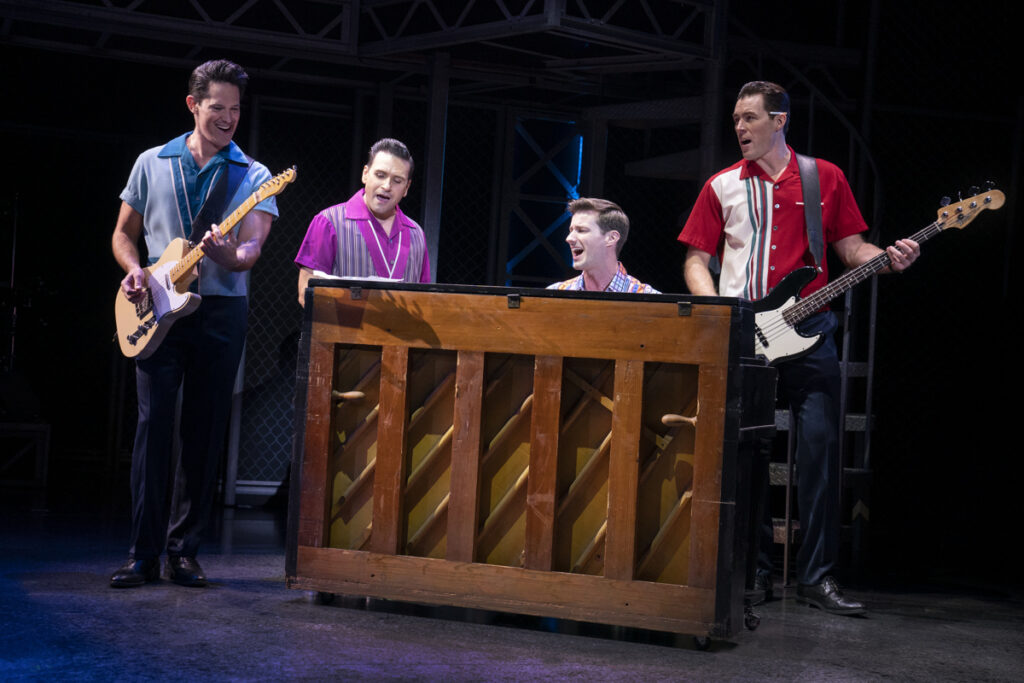
At the center is Valli, whose unmistakable falsetto becomes the band’s signature. Tommy DeVito recognizes the potential of that voice, but the group does not find its defining identity until singer-songwriter Bob Gaudio joins the lineup. With producer and lyricist Bob Crewe helping shape their sound, the renamed Four Seasons break through with “Sherry,” beginning a string of hits that includes “Big Girls Don’t Cry,” “Walk Like a Man,” “Dawn (Go Away),” “Rag Doll” and “Let’s Hang On!”
The excitement of those early successes gives Jersey Boys some of its most exhilarating moments. Des McAnuff’s original staging often lets the audience experience a song from several angles: backstage as the group prepares, from the wings as it performs and then from the imagined perspective of thousands of screaming fans. When the quartet finally turns to face the theater and the harmonies lock into place, the effect is electric. These are familiar songs, but their placement within the story allows audiences to hear them as artistic breakthroughs rather than entries on a greatest-hits playlist.
The music is irresistible, yet the show earns its dramatic credibility by refusing to make success look easy. Tommy’s debts and connections to organized crime threaten everything the group has built. Nick grows exhausted by the constant touring and internal conflict. Frankie’s devotion to the band places enormous pressure on his marriage and family life. Even as the records climb the charts, the men struggle with broken relationships, financial obligations and the realization that professional loyalty does not always produce personal happiness.
That tension is one reason Broadway aficionados continue to embrace the show. Jersey Boys has the pace and accessibility of popular entertainment, but its construction is unusually disciplined. The songs arise at carefully chosen moments and frequently comment on the action without pretending that every hit was written specifically about the event being portrayed. The show also trusts its audience to recognize the gap between public image and private reality. The matching suits, synchronized choreography and flawless harmonies conceal a group that is often barely holding itself together.
The musical opened on Broadway in 2005 and became one of the era’s biggest theatrical successes. At the 2006 Tony Awards, it won four honors, including Best Musical. John Lloyd Young received the Tony for Best Actor in a Musical for originating the role of Frankie Valli, Christian Hoff won Best Featured Actor in a Musical as Tommy DeVito and Howell Binkley earned the award for Best Lighting Design of a Musical. The production also received the Laurence Olivier Award for Best New Musical following its arrival in London.
Those accolades reflect the show’s ability to balance authenticity with theatrical craftsmanship. The performances require more than vocal resemblance. The actor playing Valli must reproduce one of pop music’s most distinctive sounds while carrying the emotional weight of a man caught between his responsibilities to his group and his family. The full quartet must achieve the tight vocal blend and precise stage presence that made The Four Seasons stars, while also creating four sharply individual characters.
Fans love Jersey Boys because it sends them home singing, but they remember it because the story gives those songs new context. “Can’t Take My Eyes Off You,” for example, arrives not merely as a familiar favorite but as a moment of professional vindication after Valli is told the song is difficult to market. “Who Loves You” becomes more than a finale; it reunites the group through the sound that first brought them together.
More than two decades after its Broadway debut, Jersey Boys remains one of the finest examples of the biographical musical done right. It has the velocity of a concert, the pleasures of a first-rate pop catalog and the dramatic complications of four men discovering that getting to the top may be simpler than surviving once they arrive.
Jersey Boys plays Whitney Hall at The Kentucky Center October 6–11, 2026. The production runs approximately two hours and 30 minutes, including one intermission. Tickets and performance information are available through Broadway in Louisville.
For tickets and more information, visit Louisville.Broadway.com